Progressions de Dragon Squat Lunge
Muscles travaillés
- Quadriceps
- Adducteurs de la hanche
- Fessiers
- Carré des lombes
- Mollet long
- Mollet court
- Calf (Gastrocnemius)
- Calf (Soleus)
Conseils de Forme
-
Tiens-toi sur une jambe avec la jambe arrière étendue derrière toi : la jambe arrière va croiser derrière et à travers la jambe d'appui pendant le mouvement
-
Gaine le tronc et commence la descente en pliant la jambe d'appui tout en balayant la jambe arrière dans un grand arc circulaire
-
Replie ton torse vers l'intérieur de ta jambe d'appui en descendant : cela crée le contrepoids nécessaire pour la position profonde
-
Garde la jambe arrière droite et étendue pendant tout le mouvement : ne plie pas le genou arrière
-
En bas, ta hanche doit être aussi proche du sol que possible avec la jambe arrière complètement étendue derrière toi du côté opposé
-
Inverse le schéma de mouvement avec contrôle pour revenir debout : c'est la partie la plus difficile
-
Garde le genou d'appui aligné avec les orteils : ne le laisse pas s'effondrer vers l'intérieur sous la demande rotationnelle
-
Respire régulièrement : expire en descendant, inspire en remontant
Progressions
01 Cross Leg Lunge
- Place ton pied arrière derrière toi, à une distance où ton genou peut toucher le sol juste derrière le talon de ta jambe avant
- Croise ton pied arrière d'environ une largeur de pied vers le côté opposé, derrière toi
- Garde le buste relativement droit, en te penchant en avant seulement autant que nécessaire pour l'équilibre
- Descends en pliant le genou avant tout en gardant l'essentiel de ton poids sur la jambe avant
- Touche le sol avec ton genou arrière juste à l'extérieur du talon de ta jambe d'appui
- Garde le genou de ta jambe d'appui stable et bien aligné, sans rotation
- Reviens en position debout sans tourner ni vriller le buste
02 Cross Leg Skater
- Place ton pied arrière derrière toi et croise-le d'environ une largeur de pied vers le côté opposé
- Décolle ton pied arrière du sol et garde-le en suspension pendant tout le mouvement
- Va chercher avec ton genou suspendu pour toucher juste à l'extérieur du talon de ta jambe d'appui
- Garde l'essentiel de ton poids et du contrôle sur ta jambe d'appui
- Essaie de revenir debout sans utiliser ton pied arrière comme appui
- N'autorise un contact léger du pied arrière que si tu en as besoin pour l'équilibre
- Maintiens une inclinaison du buste vers l'avant pour compenser le mouvement
03 Cross Leg Skater Reaching
- Commence avec ton pied arrière en suspension derrière toi et croisé vers le côté opposé
- Va chercher plus bas et plus loin avec ton genou, en travers de ta jambe d'appui
- Vise à toucher à l'extérieur des orteils de ta jambe d'appui plutôt que seulement le talon
- Laisse ton quadriceps glisser le long de l'extérieur de la cuisse de ta jambe d'appui
- Penche le buste vers l'avant et en travers pour compenser le genou qui va chercher
- Garde le buste à l'intérieur de la jambe qui va chercher pendant que tes bras s'étendent en travers
- Laisse ton buste se replier latéralement vers le bas à mesure que tu vas plus profond
04 Cross Leg Skater To Dragon Extension
- Mets-toi en place avec ton pied arrière en suspension derrière toi et croisé vers le côté opposé
- Va chercher avec ton genou en travers et vers le bas, vers l'extérieur des orteils de ta jambe d'appui
- Une fois en position croisée, étends ton genou aussi loin que possible
- Enroule-toi profondément dans la position en repliant le buste vers l'intérieur de ta jambe d'appui
- Passe tes mains depuis l'intérieur de ta jambe d'appui vers l'extérieur de ton genou et de ta cuisse
- Essaie d'amener ton pied qui s'étend là où tes mains sont placées
- Inverse tout le processus lentement et avec contrôle pour revenir debout
05 Dragon Squat Assisté à l'Élastique
Bandes de résistance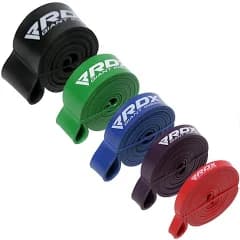
- Installe ton élastique au-dessus de toi, légèrement devant et à l'extérieur de ta jambe d'appui
- Tiens l'élastique avec ton bras du haut ou avec les deux bras pour t'aider
- Garde ta jambe libre tendue pendant tout le mouvement
- Commence sur une jambe avec les bras tendus vers l'avant
- Amène ta jambe libre en travers dans un grand cercle pendant que tu plies ta jambe d'appui
- Replie ton buste vers l'intérieur de ta jambe d'appui pendant la descente
- Sers-toi de l'élastique pour contrôler le mouvement et faciliter le retour debout
06 Dragon Squat Assisté au Sol et à l'Élastique
Bandes de résistance- Utilise un élastique plus léger que pour les méthodes d'assistance plus fortes
- Contrôle l'essentiel du mouvement sans trop t'appuyer sur l'aide de l'élastique
- Utilise ta main du bas pour une assistance minimale au sol quand tu en as besoin
- Pose ta main au sol comme pour une pompe latérale afin de guider ta descente
- N'utilise l'appui au sol que dans la position la plus basse
- Réduis progressivement l'usage de l'élastique à mesure que tu gagnes en force et en contrôle
- Concentre-toi sur l'idée de n'utiliser une aide que lorsque c'est absolument nécessaire
07 Dragon Squat Négatif Profond
- N'exécute que la phase de descente du mouvement, sans assistance
- Replie-toi profondément et va chercher pour amener ta hanche aussi près du sol que possible
- Concentre-toi sur une descente lente et contrôlée pour maximiser la phase excentrique
- Une fois en bas, pose tes mains au sol pour t'aider à te relever
- Relève-toi normalement sur les deux jambes pour sortir de la position en sécurité
- Concentre-toi sur la maîtrise du schéma de descente
- Construis ta force sur la phase excentrique avant de tenter le mouvement complet
08 Dragon Squat Assisté au Sol
- Exécute la descente complète sans assistance et avec contrôle
- N'utilise une aide minimale des mains que dans la position basse, quand c'est nécessaire
- Pose tes mains au sol pour trouver la position la plus basse et la plus efficace
- Sers-toi de l'appui au sol pour amorcer la remontée depuis le bas
- Retire l'aide des mains dès que tu quittes le niveau du sol
- Concentre-toi sur l'usage des mains uniquement pour la partie la plus difficile du mouvement
- Réduis progressivement l'appui au sol jusqu'à pouvoir l'exécuter en totale autonomie
09 Dragon Squat
- Commence sur une jambe avec ta jambe libre tendue
- Amène ta jambe libre en travers dans un grand cercle pendant que tu descends sur ta jambe d'appui
- Replie ton buste vers l'intérieur de ta jambe d'appui pour compenser
- Atteins la position la plus profonde possible tout en gardant le contrôle
- Inverse le schéma de mouvement avec contrôle pour revenir en position debout
- Garde ta jambe libre tendue sur toute l'amplitude du mouvement
Erreurs fréquentes
Intégré à un programme conçu pour toi
Chaque exercice s'adapte à tes objectifs, ton équipement et ton emploi du temps dans l'app.