Throwing Bounces Progressions
Form Cues
-
These progressions use resistance bands to develop ballistic control of the shoulder's internal rotation: critical for throwing movements.
-
Anchor a resistance band behind you and hold it with both hands in an externally rotated shoulder position.
-
Perform small, rhythmic bouncing movements at end range to build elastic strength in the subscapularis and internal rotators.
-
Progress through seated, standing, contralateral, and split-stance variations to increase demand and functionality.
-
Keep the bounces controlled and rhythmic: the goal is elastic tissue adaptation, not maximum force.
-
Maintain core stability throughout all variations to protect the spine and maximize shoulder loading.
-
Breathe steadily throughout: avoid holding your breath during the bouncing.
-
Work both sides evenly when performing unilateral variations.
Progressions
01 Seated Subscap Bounces
Bands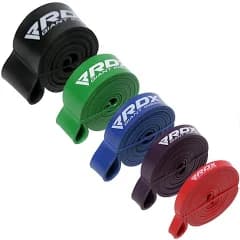
-
Sit on the floor with a resistance band anchored behind you at roughly shoulder height.
-
Hold the band with both hands, arms extended behind you in an externally rotated shoulder position.
-
Perform small, controlled bouncing movements at the end range of the throwing motion: think gentle pulses, not large swings.
-
Focus on activating the subscapularis and internal rotators of the shoulder through the rhythmic bouncing.
-
The seated position provides a stable base, allowing you to focus entirely on shoulder mechanics.
-
Keep your core engaged and torso upright throughout: avoid leaning or swaying with the bounces.
-
Breathe steadily and maintain a consistent rhythm for 15-20 bounces per set.
-
Complete the prescribed sets, then switch sides if performing unilaterally.
-
02 Standing Subscap Bounces
Bands-
Stand upright with feet hip-width apart, resistance band anchored behind you at roughly shoulder height.
-
Hold the band with both hands, arms extended behind you in an externally rotated shoulder position.
-
Perform small, controlled bouncing movements at the end range of the throwing motion.
-
The standing position increases the core stability demand compared to the seated variation: brace your abs to stay upright.
-
Keep your torso stable and avoid arching your lower back or swaying during the bounces.
-
Pack your shoulders down and back: avoid shrugging toward your ears during the exercise.
-
Maintain a consistent, rhythmic bouncing pattern for 15-20 bounces per set.
-
Breathe steadily throughout: do not hold your breath during the bouncing.
-
03 Standing Contra Subscap Bounces
Bands-
Stand with feet hip-width apart, resistance band anchored behind you, and rotate your torso slightly away from the anchor point (contralateral position).
-
Hold the band and perform small, controlled bouncing movements at the end range of the throwing motion.
-
The rotated torso position targets the subscapularis at a more functional throwing angle, mimicking real throwing mechanics.
-
Maintain core stability throughout: avoid excessive rotation or twisting beyond the set position during the bouncing.
-
Keep the bouncing rhythmic and controlled: small pulses at end range, not large sweeping movements.
-
Pack your shoulders down and back to avoid upper trap dominance during the exercise.
-
Breathe steadily and maintain the contralateral rotation consistently throughout each set.
-
Complete the prescribed sets on one side before switching to the other side.
-
04 Standing Contra Subscap Deep Bounces
Bands-
Stand in a split stance with one foot forward, resistance band anchored behind you, torso rotated away from the anchor point (contralateral).
-
Hold the band and perform deeper, more pronounced bouncing movements at end range compared to previous variations.
-
The split stance provides a wider base of support, allowing you to generate deeper bouncing safely.
-
This variation most closely mimics the full throwing motion: the deeper range trains the elastic properties of the shoulder tissues.
-
Maintain core stability and control throughout: brace your abs and keep your spine neutral despite the deeper movement.
-
Focus on feeling the subscapularis and shoulder internal rotators working actively at end range.
-
Keep the movement rhythmic and controlled: do not force range of motion or bounce aggressively.
-
Complete the prescribed sets on one side before switching to the other side.
-
Common mistakes
Built into a program made for you
Every exercise here adapts to your goals, equipment and schedule inside the app.